
Relatively warm deep-water formation persisted in the Last Glacial Maximum
Article Date: 21 January 2026
Article URL: https://www.nature.com/articles/s41586-025-10012-2
Article Image: 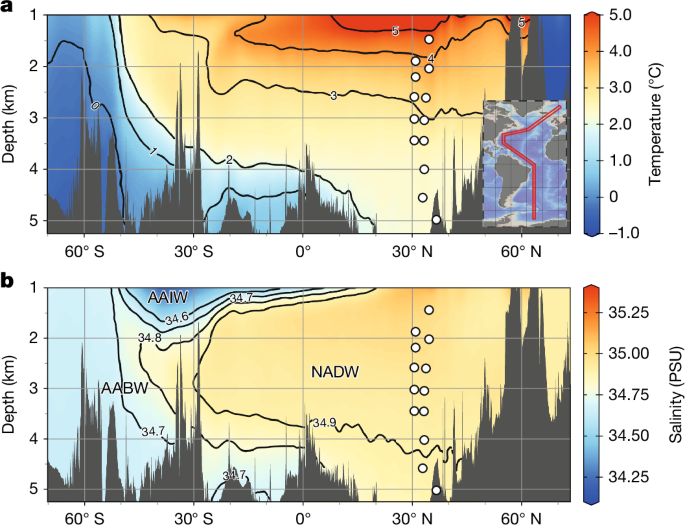
Summary
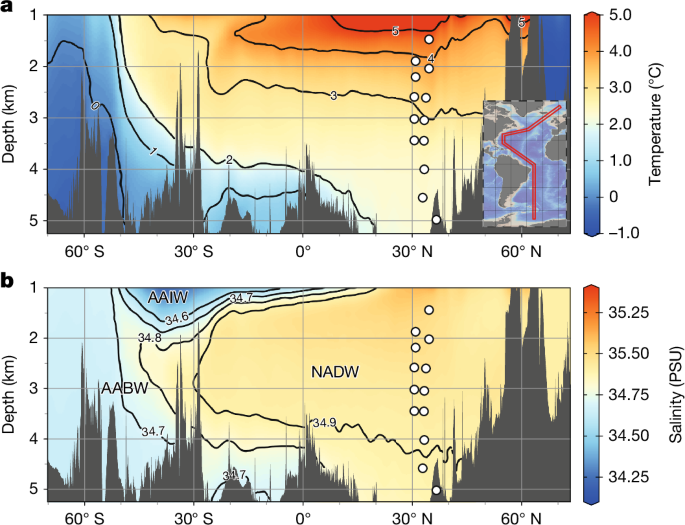
This Nature paper presents multi-proxy geochemical reconstructions (Mg/Ca, Mg/Li, clumped isotopes Δ47 and paired δ18O) from 16 North Atlantic sediment cores that span ~1.5 km to >5 km water depth. The authors reconstruct seawater temperature and ice-volume-corrected δ18O (δ18O_sw-ivc) for the Last Glacial Maximum (LGM) and compare these to mid-to-late Holocene and modern observations. Contrary to earlier pore-water studies that inferred near-freezing glacial deep waters, the new proxies indicate that much of the deep North Atlantic—where modern North Atlantic Deep Water (NADW) sits—remained relatively warm (about 0–2 °C) during the LGM and likely saltier than in the Holocene. The high δ18O_sw-ivc signature can be traced from the western subtropical Atlantic along the Gulf Stream and North Atlantic Current into the subpolar formation regions, implying sustained deep-water formation fed by saltier subtropical source waters. The study highlights subtropical hydroclimate (negative P−E) and a stronger gyre as drivers, and discusses implications for AMOC behaviour and model evaluation.
Key Points
- Multi-proxy temperature reconstructions (Mg/Ca, Mg/Li, Δ47) from 16 cores show LGM deep-North-Atlantic temperatures of ~0–2 °C—only ~1.8 ± 0.5 °C colder than modern NADW at equivalent depths.
- Ice-volume-corrected δ18O_sw (δ18O_sw-ivc) in the LGM North Atlantic is higher than Holocene values by ~0.3–0.5‰, consistent with saltier source waters feeding NADW.
- The high δ18O_sw-ivc signal can be traced along the surface pathway (western subtropics → Gulf Stream → NAC) into the subpolar deep-water formation regions and then at depth into the Northwest Atlantic, indicating sustained glacial deep-water formation.
- Subtropical hydroclimate changes (negative precipitation minus evaporation, P−E) and a deeper/stronger subtropical gyre likely increased near-surface salinity and supported continued deep convection despite colder climates.
- These proxy results contrast with earlier pore-water-based reconstructions that suggested near-freezing NADW; methodological assumptions in pore-water work likely contributed to that discrepancy.
- Implications: NADW formation persisted at different loci and via multiple modes in the LGM; climate models must capture diverse formation processes and regional salinity signals to predict AMOC behaviour reliably.
Context and relevance
Understanding how and where deep water formed during the LGM is central to reconstructing past Atlantic Meridional Overturning Circulation (AMOC) strength and its role in global climate and carbon storage. This study provides direct temperature and δ18O_sw constraints from a depth transect across the North Atlantic, strengthening evidence that glacial NADW was prevalent and relatively warm/salty compared with previous interpretations. The work links oceanic hydrography to subtropical hydroclimate forcing (P−E) and wind-driven gyre dynamics—factors that also matter for future AMOC projections under climate change. The dataset and code are publicly archived (PANGAEA, Zenodo), offering useful test-bed targets for isotope-enabled and high-resolution ocean models.
Why should I read this?
Because if you care about how the Atlantic conveyor behaved during the last ice age (and what that says about model skill and future ocean change), this paper saves you the digging. The authors read a messy archive so you don’t have to: multi-proxy measurements, rigorous cross-checks and a coherent picture that NADW kept forming from salty, relatively warm waters — even in the coldest state of the last glacial. Short version: the deep Atlantic wasn’t as frozen as some older studies claimed, and that matters for AMOC and climate-model evaluation.
Author style (punchy)
Punchy take: sustained, salty, warm-ish NADW in the LGM. This isn’t a subtle tweak to prior thinking — it challenges pore-water reconstructions and strengthens the case that diverse formation sites and subtropical forcing kept the overturning engine running. If you work on palaeoceanography, AMOC, or climate modelling, read the methods and supplementary data — it’s a compact test set for models.
Source
Data and code: PANGAEA dataset DOI and Zenodo code repository are linked in the paper.