
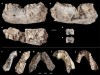
A variety of early hominin species shared the Afar region of Ethiopia
Article Date: 21 January 2026
Article URL: https://www.nature.com/articles/d41586-025-03727-9
Article Image: https://media.nature.com/lw100/magazine-assets/d41586-025-03727-9/d41586-025-03727-9_51822036.jpg
Summary
New analyses and recently reported fossils show that the Afar region of northern Ethiopia hosted at least four distinct hominin types between roughly 3.0 and 2.4 million years ago — including members attributable to Paranthropus, Australopithecus and early Homo. Two new papers (Alemseged et al. and Villmoare et al.) provide fossils and contextual data that extend the geographic and temporal range of some taxa and reveal overlapping occupations of the same landscape. The finds emphasise diversity, ecological flexibility and the potential for sympatry among early hominins in eastern Africa.
Key Points
- Fossil evidence indicates at least four different hominin types were present in the Afar between ~3.0 and 2.4 Ma.
- Paranthropus is now shown to have a broader distribution and temporal overlap with other hominins in the region.
- The discoveries come from new fieldwork and reanalysis of remains from Ledi-Geraru and adjacent Afar deposits.
- Coexistence implies niche partitioning or ecological flexibility rather than simple serial replacement.
- Authors caution that sampling bias and dating precision still limit how precisely interactions can be reconstructed.
Content summary
The Nature News & Views piece discusses two recent research papers that add crucial fossil data from Afar. Together they document multiple hominin morphologies in overlapping time windows, expanding known ranges for Paranthropus and detailing additional Australopithecus and early Homo material from Ledi-Geraru and neighbouring sites. Cranial and dental features, combined with stratigraphic and dating evidence, support a picture of contemporaneous hominin lineages occupying a mosaic of environments. The author highlights the implications for interpreting early hominin behaviour, diet and population structure, while noting limits imposed by preservation and sample size.
Context and relevance
This work changes how we think about early Pliocene–Pleistocene hominin communities. Rather than a single lineage replacing another, the Afar evidence supports a more complex scenario with multiple hominin types coexisting and exploiting different resources or habitats. That has implications for debates on how and why Homo emerged, how robust taxa like Paranthropus fitted into ecosystems, and how ecological pressures shaped anatomy and behaviour. For researchers and enthusiasts following human origins, these papers supply fresh data that feed models of sympatry, competition and adaptive diversity in early hominins.
Why should I read this?
Short version: if you care about human origins, this is the neat update that messes with tidy stories. Multiple hominins living in the same neighbourhood means the evolutionary plot is thicker than we thought — and these papers drop key fossils and context. We’ve done the slog so you don’t have to.
Author style
Punchy: this is a significant set of findings. The reporting highlights how new fossil and contextual data force a rethink of hominin diversity and coexistence in one of the most important regions for human origins. Read the underlying papers if you want the full morphological and stratigraphic detail — they matter for the big-picture story.