
10 edge computing trends to watch in 2026 and beyond
Summary
Edge computing is moving from niche deployments to a core part of enterprise strategy as connected devices and edge-generated data volumes explode. The article explains why organisations are shifting compute and intelligence closer to endpoints and outlines the major developments shaping edge through 2025 and into 2026 — from device improvements, increased spending and new deployment models, to security, privacy and the rise of edge AI powered by faster networks such as 5G (and eventually 6G).
Key Points
- Digital readiness at board level is accelerating enterprise edge adoption for customer experience, resilience and cost efficiency.
- Edge device design and management tools are improving — more rugged, power-efficient and easier to operate at scale.
- Global spending on edge solutions is rising sharply, with major investments across automotive, healthcare, manufacturing and retail.
- Edge is expanding beyond gateways to include micro data centres, telco-hosted infrastructure and cloud provider local zones.
- Distributed deployments create infrastructure challenges: power, cooling, physical security and site access become material issues.
- Security threats targeting edge and IoT devices are increasing; organisations must bake-in security from the start.
- Data privacy concerns grow as more personal and operational data is captured at the edge and shared across parties.
- Edge hardware is becoming more powerful (eg. advanced chips), enabling on-device AI and richer local processing.
- Edge AI and specialised AI chips (eg. NVIDIA Jetson) will unlock new low-latency, offline ML use cases.
- 5G rollout (and eventual 6G) greatly enhances edge capabilities by lowering latency and increasing throughput for critical applications.
- Maturing edge tech expands use cases — from robotics and spatial computing to autonomous systems in remote locations.
- Sustainability gains are possible via lower bandwidth usage and energy-efficient edge hardware, including emerging analog edge chips.
Content summary
The article begins by framing edge computing as the response to a massive increase in IoT and edge-enabled devices and the data they generate. Estimates vary, but billions of connected devices and rapid data growth make processing at or near the source essential.
Key drivers include cost and bandwidth savings, privacy and compliance, business continuity, and vertical-specific requirements. Vendors are shipping more rugged, efficient and manageable edge devices, and management platforms are making distributed operations more practical.
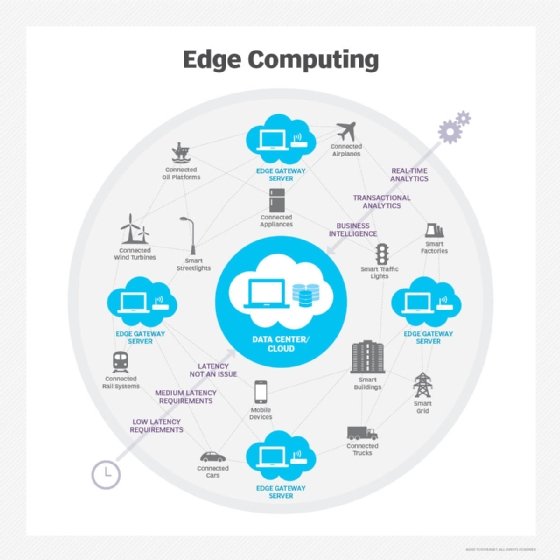
Spending on edge solutions is projected to climb strongly over the next few years. Organisations are deploying a broader set of edge types — on-premise gateways, micro data centres, telco edge locations and cloud provider local zones — each suited to different latency, regulatory and scale needs.
That distribution brings headwinds: powering, cooling and securing remote assets is non-trivial, and the public placement of equipment raises theft and tampering risks. Security is a top barrier to faster adoption, and numerous threat vectors target endpoints, RAN, edge servers and supply chains.
On the upside, more powerful chips and AI-optimised edge hardware are enabling on-device inference and new hybrid cloud–edge architectures. 5G accelerates many use cases by reducing latency; 6G is on the horizon and could further expand possibilities. The maturing stack is spawning use cases from immersive spatial computing to autonomous operations in remote or outer-space contexts. Finally, edge computing can help sustainability efforts through reduced bandwidth needs and lower-power specialised chips.
Context and relevance
This article is important for technology leaders, architects and product teams planning infrastructure or AI deployments. It ties together market trends (spend, device counts), technical progress (chips, management software), and risks (security, physical ops) so you can balance opportunity and operational reality. The piece is particularly relevant if you’re designing low-latency services, industrial IoT, retail/transport systems or edge-enabled AI — the decisions you make about where to place compute will affect performance, cost and compliance.
Why should I read this?
Quick and blunt: if you work with IoT, AI or low-latency apps, this gives you the headlines you need to avoid being blindsided. It explains what’s driving edge growth, the practical limits (security, ops), and why 5G + smarter edge chips suddenly make previously impossible use cases doable. Read it to spot opportunities and the traps you must design around.
Source
Source: https://www.techtarget.com/searchcio/tip/Top-edge-computing-trends-to-watch-in-2020