
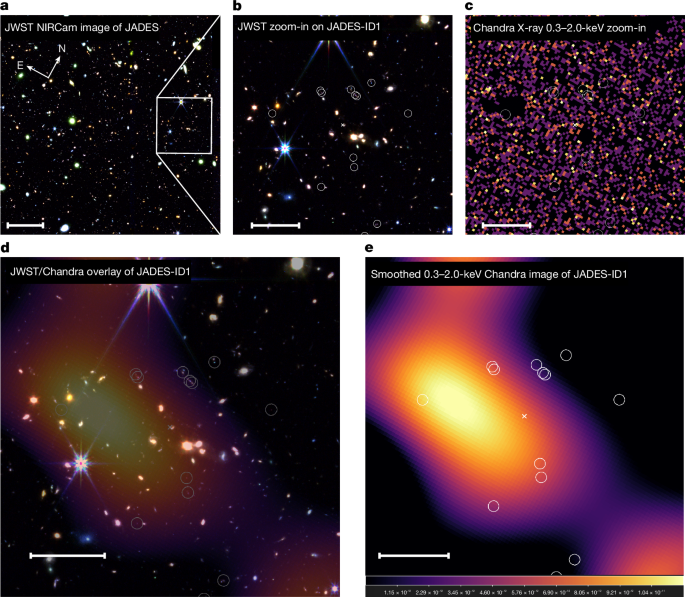
An X-ray-emitting protocluster at z ≈ 5.7 reveals rapid structure growth
Article Date: 28 January 2026
Article URL: https://www.nature.com/articles/s41586-025-09973-1
Article Image: https://media.springernature.com/lw685/springer-static/image/art%3A10.1038%2Fs41586-025-09973-1/MediaObjects/41586_2025_9973_Fig1_HTML.png
Summary
Using deep JWST imaging and the deepest Chandra X-ray observations in the Chandra Deep Field South (total exposure 6.55 Ms), the authors identify extended X-ray emission cospatial with a strong galaxy overdensity (JADES-ID1) at z ≈ 5.68. The X-ray signal is detected in the 0.3–2.0 keV band out to ≈125 kpc (21″) with 142 ± 45 net counts after careful point-source masking and background treatment. A hardness-ratio analysis implies a hot intracluster medium (ICM) temperature ≥ ~2.5 keV. Applying standard scaling relations yields a bolometric luminosity Lbol ≈ 1.5 × 10^44 erg s^−1 and an estimated total mass M500 ≈ (1.8^{+0.6}_{−0.7}) × 10^13 M⊙. The combined JWST overdensity (≈4.2σ) and Chandra detection likelihood (≈5.0σ) give a joint significance of ≈6.9σ. The detection is robust against alternative explanations (resolved or stacked AGN, inverse-Compton) and suggests the onset of virial heating only ~1 billion years after the Big Bang.
Key Points
- JADES-ID1 is a rich JWST-identified protocluster at z ≈ 5.68 with about 66 candidate member galaxies and a high inferred halo mass.
- Deep Chandra imaging reveals extended soft X-ray emission (0.3–2.0 keV) spatially coincident with the JWST overdensity, detected out to ≈125 kpc.
- Hardness-ratio constraints imply an ICM temperature of at least ≈2.5 keV; bolometric L ≈ 1.5 × 10^44 erg s^−1 and estimated M500 ≈ 1.8 × 10^13 M⊙ (with systematic caveats).
- The combined JWST + Chandra significance reaches ≈6.9σ, and the chance of finding such a massive halo in the small JADES/CDFS volume is extremely low under vanilla ΛCDM (probabilities ≲ 10^−4–10^−7 for comparable masses).
- Extensive tests rule out contamination from resolved or stacked AGN and inverse-Compton emission from radio lobes; the thermal ICM interpretation is favoured.
- The result implies that virial heating and substantial ICM formation can begin much earlier in the most massive protoclusters than commonly expected.
- Future deep X-ray and SZ facilities (Lynx/LEM/NewAthena/CMB-HD, AtLAST) plus JWST will be essential to map similar early structures and test implications for structure formation.
Why should I read this?
Short version: this paper spots hot intracluster gas when the Universe was only ~1 billion years old. It’s rare, surprising and could mean some cosmic structures grew way faster than we thought — so if you care about how the first massive clusters formed (or whether ΛCDM fully explains early structure), read it.
Context and relevance
This detection is one of the earliest direct X-ray signatures of a forming ICM and ties into a string of JWST discoveries that find unexpectedly massive or luminous objects at high redshift. If confirmed in more fields, these objects will constrain halo assembly, early heating processes (shocks, mergers), and potentially probe tensions with theoretical halo-abundance expectations. The multi-wavelength approach (JWST for galaxy overdensities; Chandra for faint thermal emission; radio/SZ checks to exclude alternatives) sets a template for locating and confirming the first virialising systems. The result is therefore important for observers planning follow-ups and for modellers of early structure formation.
Author style
Punchy and to the point: the team combines the deepest available JWST and Chandra data to make a compelling case for a hot ICM at z ≈ 5.7. Given the statistical significance and careful exclusion of non-thermal alternatives, this is a high-impact detection that stretches our picture of how quickly massive haloes can assemble.