
Optofluidic three-dimensional microfabrication and nanofabrication
Summary
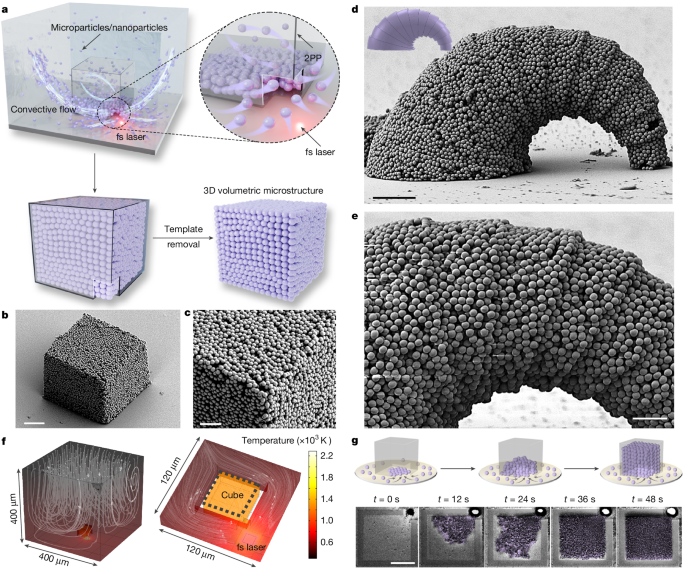
This Nature paper presents an optofluidic 3D microfabrication and nanofabrication strategy that combines two-photon polymerisation (2PP) printed hollow microtemplates with light-driven fluid flows (generated by a femtosecond laser) to rapidly and deterministically assemble diverse microparticles and nanoparticles into truly volumetric free-form 3D micro- and nanoarchitectures. After assembly inside the template the polymer scaffold is removed to yield free-standing structures made from a wide range of materials (SiO2, TiO2, Fe3O4, diamond, Ag, quantum dots, nanowires, etc.). The method overcomes a key limitation of conventional 2PP — its restricted material compatibility — and demonstrates fast assembly rates, high structural integrity and on-demand fabrication of multifunctional microdevices such as sieving microvalves and multimodal microrobots.
Key Points
- Combines 2PP-printed hollow templates with femtosecond-laser-induced optofluidic flows to guide particulate assembly into 3D volumes.
- Non-specific, flow-driven mechanism assembles very diverse materials (metals, oxides, diamond, quantum dots, nanowires) into free-standing 3D architectures.
- Assembly speeds reported around 700 μm3 s−1 for 1 μm SiO2 and particle-assembly efficiencies up to ~10^5 particles min−1 — faster than typical 2PP printing for equivalent volumes.
- Control knobs: ionic strength, solvent choice, surfactant concentration and laser scan speed (flow speed). A phase diagram shows clustering domains vs flow speed and salt concentration; critical flow speed ~300 μm s−1.
- Demonstrated devices: colloidal microvalves for size-selective sieving and microrobots integrating magnetic, catalytic and light-active materials with multimodal locomotion.
- Limitations and caveats: excessive inter-particle attraction can clog template openings; post-treatments (O2 plasma, annealing) may be required to improve interparticle bonding and mechanical properties.
Content summary
The authors print hollow polymeric microtemplates by 2PP, immerse them in particle suspensions, then focus a femtosecond laser near the template opening. Local heating produces a strong temperature gradient and convective flow (plus Marangoni flow from laser-induced bubbles), transporting particles into and filling the template. Assembly is governed by competition between DLVO (van der Waals + EDL) inter-particle forces and hydrodynamic (Stokes) forces; when the net energy change favours attraction (ΔU_total < 0) particles cluster and lock into place. The team maps clustering behaviour across salt concentration and flow speed, and shows solvent and surfactant choices can greatly enhance assembly (hydrophobic solvents or surfactants like CTAB reduce repulsion and/or moderate Marangoni flow to aid clustering).
They demonstrate broad compatibility by assembling spheres, mixtures of sizes, nanowires and nanoparticles into diverse shapes (croissant, screw-like helices, letters and microcubes), and produce functional microdevices: microfluidic chips with colloidal microvalves that filter nanoparticles, and multimaterial microrobots with magnetic, light-driven and chemical-actuation modes. Templates are removed by plasma and annealing to yield robust, free-standing architectures.
Context and relevance
This work addresses a major bottleneck in high-resolution 3D micro/nanofabrication: the limited set of materials directly printable by two-photon polymerisation. By moving from direct photopolymerisation of functional inks to template-guided, optofluidic-directed assembly, the technique unlocks volumetric 3D architectures made from conventional inorganic and multifunctional nanomaterials. That matters for fields such as reconfigurable photonics, micro-robotics, microfluidics, sensors and on-chip device fabrication where material functionality (optical, catalytic, magnetic, mechanical) is essential and cannot be provided by polymer-only prints. The combination of deterministic template geometry and tuneable, non-specific assembly flow is a promising platform for integrating heterogeneous materials at micrometre and submicrometre scales.
Why should I read this?
Short answer: because it’s a clever cheat that gets you real 3D micro-objects out of materials 2PP alone can’t touch. If you care about making tiny devices from metals, oxides, diamond or quantum dots — fast and in true 3D — this paper shows a practical route and the control knobs you’ll need. It’s packed with hands-on recipes: when to add salt, oil or surfactant, how laser speed changes flow, and how to avoid clogged holes. In other words, quick wins for lab groups wanting to move beyond polymer-only microprints.
Author note
Punchy take: this is a step-change. The team doesn’t just tweak existing nanoscale printing — they couple optical heating, fluid mechanics and colloid science to assemble functional matter into actual 3D architectures. For anyone building microdevices or microrobots, it’s highly relevant and worth digging into the methods and phase diagrams.
Source
Article Date: 28 January 2026
Source: https://www.nature.com/articles/s41586-025-10033-x