
Ferromagnet-like binary switching of a Stoner–Wohlfarth antiferromagnet
Summary
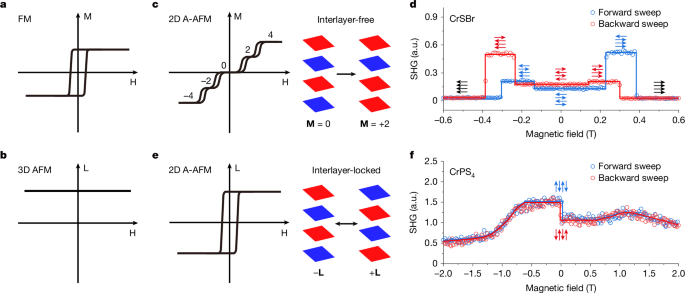
This paper reports that few-layer CrPS4 — an air-stable van der Waals A-type antiferromagnet — shows ferromagnet-like, binary 180° switching of its Néel vector under a small out-of-plane magnetic field. Using second-harmonic generation (SHG) microscopy and reflective magnetic circular dichroism (RMCD), the authors reveal an odd–even layer contrast (SHG detects switching in even layers; RMCD shows switching in odd layers) and identify an interlayer-locked switching regime where all layers flip coherently rather than layer-by-layer. Micromagnetic simulations and an extended Stoner–Wohlfarth model introduce an interlayer exchange length (l_ex) that predicts whether an A-type AFM will behave as a Stoner–Wohlfarth antiferromagnet (interlayer-locked) or as interlayer-free (layer-by-layer flipping). The work is supported by experiments on CrPS4, comparison with CrSBr (interlayer-free) and MnBi2Te4, and detailed modelling of domain-wall-mediated switching and coercive fields.
Key Points
- Few-layer CrPS4 exhibits interlayer-locked, FM-like binary switching of the Néel vector: all layers flip together under small fields (sub-0.1 T) rather than in a layer-by-layer sequence.
- SHG is sensitive to the antiferromagnetic order (even layers show SHG hysteresis), while RMCD reveals uncompensated magnetisation in odd layers — together these techniques expose the odd–even contrast in switching.
- The authors extend the Stoner–Wohlfarth model to include interlayer antiferromagnetic exchange and define an exchange length l_ex = sqrt(|J_perp| d / (2K)) that controls coherent vertical switching.
- Micromagnetic simulations reproduce a phase diagram (interlayer-locked vs interlayer-free) and show domain-wall-mediated lateral reversal even when vertical switching is coherent.
- Practical implications: coherent AFM switching with zero stray field and ultrafast dynamics could be exploited in higher-density, low-interference spintronic devices; switching properties are tunable by stacking, strain, interlayer spacing or electrostatic gating.
Context and relevance
Antiferromagnets promise faster dynamics and no stray fields compared with ferromagnets, but coherent 180° control of the Néel vector has been rare. This study identifies a clear materials class and a simple criterion (the interlayer exchange length) that predicts when layered A-type AFMs will switch coherently like a single-domain Stoner–Wohlfarth magnet. That links fundamental magnetism, nonlinear optical probing (SHG), and device-relevant control knobs (stacking, strain, doping) — a neat step towards incorporating 2D antiferromagnets into spintronic architectures.
Why should I read this?
Quick and to the point: if you care about next-gen spintronics or 2D magnets, this paper shows a clean way to get antiferromagnetic stacks to behave like single-domain ferromagnets — but with zero stray field. It saves you the bother of wading through messy multidomain AFM data and gives a usable physical parameter (l_ex) and experimental fingerprints (SHG vs RMCD odd–even signature) to spot candidate materials.
Author style
Punchy: the authors demonstrate a clear, experimentally backed route to a new class of “Stoner–Wohlfarth AFMs” and tie it to an intuitive model and simulations. For researchers in magnetism and spintronics this is highly relevant — read the details if you want to exploit coherent AFM switching or screen materials for device integration.
Source
Article date: 28 January 2026