
Holistic motor control of zebra finch song syllable sequences
Article Date: 28 January 2026
Article URL: https://www.nature.com/articles/s41586-025-10069-z
Article Image:
Summary
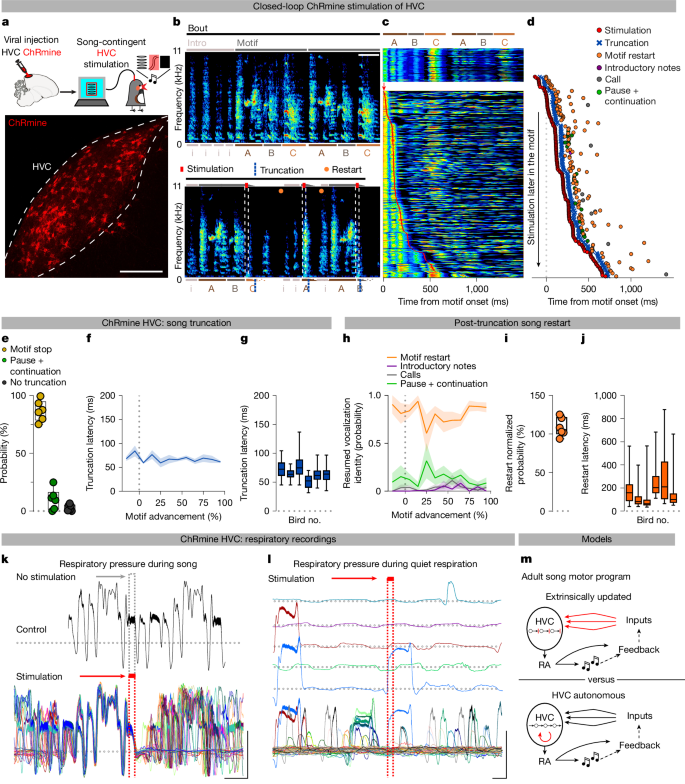
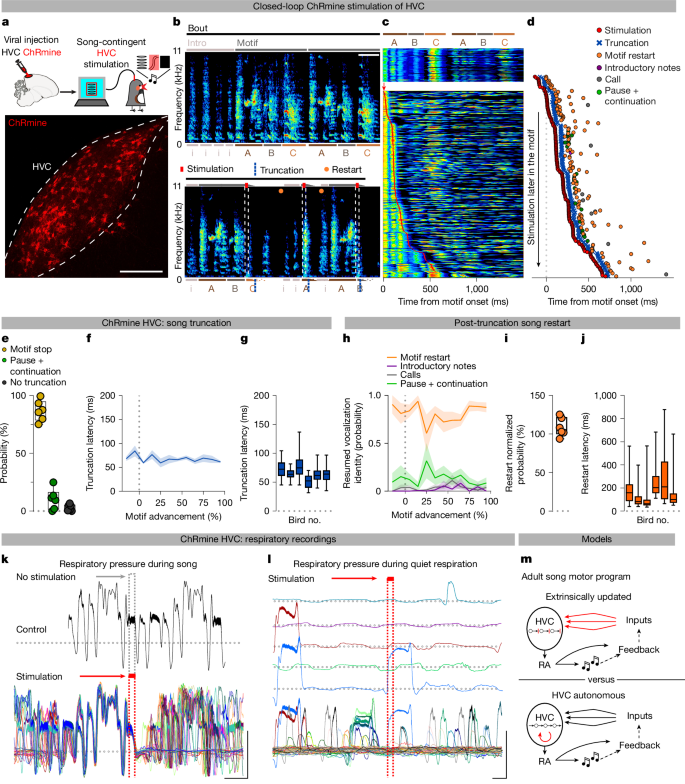
This Nature paper shows that the zebra finch cortical premotor region HVC can generate and sustain the full learned song motif largely autonomously. Using cell-type-selective optogenetics, lesions, electrophysiology, synaptic mapping and computational modelling, the authors demonstrate that: optogenetic excitation of HVC reliably truncates ongoing song and causes a rapid restart of the motif (a “skipping-record” reset); thalamic input from nucleus Uvaeformis (Uva) is required mainly for initiating motifs but not for syllable-to-syllable transitions; main pallial afferents to HVC (NIf, mMAN, Av) are dispensable for adult motif completion; and two classes of HVC projection neurons (HVC RA and HVC X) form a locally connected, inhibition-stabilised circuit that generates sequential activity and supports restarting. Selective suppression of HVC X transmission (TeNT expression) produced progressive premature truncations and restarts, matching model predictions for a heterosynaptic sequence-generating network.
Key Points
- HVC can autonomously generate the entire learned song motif once permissively initiated by thalamic input.
- Closed-loop optogenetic excitation of HVC causes rapid syllable truncation and consistent restarting from the motif beginning.
- Uva (thalamus) is necessary for motif initiation and chaining of motifs, but not for intra-motif transitions or completion.
- Main pallial afferents to HVC (NIf, mMAN, Av) are not required for adult motif completion; their removal causes only transient or no lasting disruption.
- Both HVC RA and HVC X projection neurons contribute to pattern generation; HVC X stimulation can trigger truncation and restart with HVC-like timing.
- Synaptic mapping shows monosynaptic and polysynaptic interactions between HVC X and HVC RA neurons plus interneurons—supporting a heterosynaptic network for sequence propagation.
- A computational inhibition-stabilised model reproduces truncation and restart dynamics and predicts effects of degrading HVC X transmission.
- Selective TeNT-mediated suppression of HVC X transmission causes premature truncations and restarts, validating the model’s prediction.
Content Summary
The authors combined precise, cell-type-specific optogenetics with pathway-specific lesions and slice physiology in adult male zebra finches to probe how HVC controls the ordered syllable sequence of the species-typical motif. Closed-loop light stimulation of HVC produced a fast disruption of respiration and a rapid acoustic truncation, almost always followed by restarting the motif from the beginning. By contrast, selective activation or inhibition of the Uva→HVC pathway showed little effect on within-motif transitions; instead, Uva lesions or synaptic block reduced the ability to start and chain motifs, indicating a permissive role for initiation and interhemispheric coordination.
Sequential lesions of major pallial afferents (NIf, mMAN, Av and lMAN) caused only temporary declines in motif quality that recovered, indicating that adult HVC does not require these inputs to propagate the learned sequence. Targeted stimulation of downstream (RA) or basal-ganglia-pathway (area X) nodes produced truncation or modest spectral effects, but the pattern of truncation/restart timing led the authors to localise the core pattern generator to HVC itself.
Optogenetic activation targeted to HVC X neurons recreated HVC-wide truncation and restart dynamics; synaptic circuit mapping in slices showed HVC X→RA and HVC X→X interactions (mono- and polysynaptic) sufficient to influence local dynamics. The authors built a continuous attractor/inhibition-stabilised rate model with HVC RA, HVC X, local and global inhibitory pools and a peri-song initiator population driven by Uva input. The model reproduces truncation and automatic restarting and predicts that weakening HVC X transmission yields stochastic premature truncations—confirmed in vivo by TeNT in HVC X neurons.
Context and Relevance
This work addresses a long-standing question about whether a cortical premotor nucleus (HVC) passively follows instructive inputs or actively generates and sustains learned motor sequences. The data argue for a holistic, pattern-generating role for HVC in adult, crystallised song: once permissively initiated by thalamic input, HVC can propagate the whole motif independent of major extrinsic excitatory pathways. That reframes how we think about motor “chunking” and sequence concatenation in skilled behaviours and gives a mechanistic bridge between central pattern generator concepts and cortical sequence coding.
Why should I read this?
Want to know how a brain turns practiced building blocks into a seamless routine? This paper shows HVC behaves like a self-sufficient sequence engine: start it, poke it, and it snaps back to the top of the song like a skipping record. If you care about motor sequencing, speech and language models, basal-ganglia–cortex interactions or CPG-like cortical dynamics, this is exactly the kind of hard, causal evidence that saves you time — the authors ran the tricky cell-specific perturbations and modelling so you don’t have to.
Author style
Punchy. The study is presented with clear causal experiments and matched computational predictions. If your work touches motor control, sequence learning or neural rhythm generation, the results are highly relevant — the authors make a strong case that HVC holistically controls a naturally learned motor sequence, not merely relays it.