
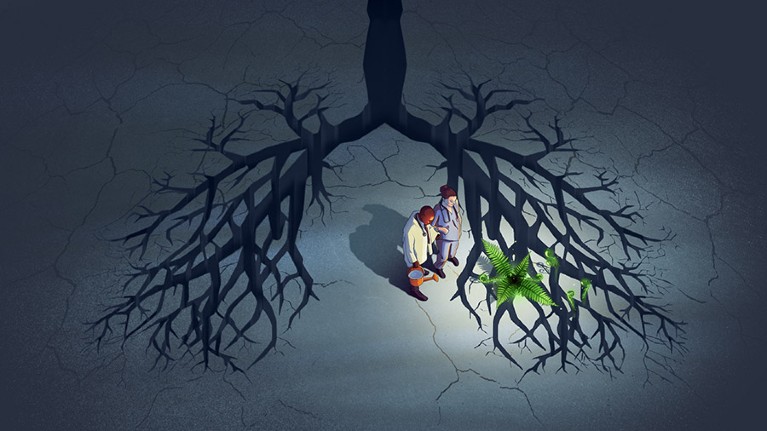
Could the regenerative power of the lungs help to reverse disease?
Summary
The lungs have far greater regenerative capacity than was long assumed. New work shows specialised lung cells can switch identity and act like stem cells to rebuild tissue after injury, and that crosstalk between epithelial cells and fibroblasts guides repair. Faulty or prolonged transitional cell states appear to underpin both emphysema (COPD) and fibrosis (IPF), suggesting a shared malfunctioning repair programme. Ageing and cellular senescence are major barriers to regeneration, but early-stage approaches — from senolytic drugs to targeted modulation of cell states and biomarkers to monitor recovery — offer routes towards slowing, halting or even reversing chronic lung disease.
Key Points
- Human lungs can regrow substantial tissue; documented cases show compensation and new alveoli formation after lung resection.
- Lung cells are unusually plastic: differentiated AT2 cells can become AT1 cells to rebuild alveoli when required.
- Normal repair depends on transient transitional cell states and precise epithelial–fibroblast signalling; persistence of these states drives fibrosis, while their absence can lead to emphysema-like change.
- Ageing and senescence block regeneration; senescent cells secrete factors that perpetuate inflammation and dysfunction.
- Senolytics and senomorphics (e.g. dasatinib+quercetin, metformin under study) show early promise but require careful timing to avoid disrupting normal repair.
- Physiological forces (breathing mechanics) and oxygen levels (hypoxia) influence cell fate and disease progression.
- Translating findings demands better human models, time-sequenced therapies that coax cells back to healthy states, and robust biomarkers to track regeneration and prognosis.
Content summary
Recent advances — single-cell atlases, lung organoids, live lung-slice cultures and spatial ‘omics — reveal roughly 70 lung cell types and a surprising level of cell plasticity. Studies show that alveolar repair hinges on coordinated interactions between AT2 cells (which can act as progenitors), alveolar fibroblasts (which build the extracellular matrix) and immune cells. When transitional gene programmes remain active too long or are misregulated, fibroblasts continue remodelling and deposit excess matrix, producing fibrosis; conversely, failure to enter or complete transitional programmes can thin the interstitium and lead to emphysema. Age-related senescence compounds these problems by locking cells into non-regenerative states and spreading dysfunction via extracellular vesicles.
Therapeutic strategies under exploration include targeting chromatin features unique to diseased states, using peptides or small molecules to nudge cells through correct transitional programmes, and clearing or modulating senescent cells. Lessons from COVID-19 and influenza highlight how acute infections can leave long-lasting cellular ‘memories’ that predispose tissue to degenerative disease. Researchers caution that human translation is hard: mouse models differ from humans, organoids are limited, and timing — hitting the right cell, at the right time — will be crucial.
Context and relevance
This work matters because COPD is the third leading cause of death worldwide and IPF remains largely fatal even with transplantation. Reframing lung disease as a problem of misdirected regeneration opens new therapeutic avenues beyond symptomatic care. For clinicians, scientists and drug developers, the article outlines mechanistic targets (cell states, senescence, ECM remodelling) and practical hurdles (ageing, model limitations, delivery and timing). It also connects acute‑infection damage (including COVID‑19) to long‑term degenerative changes, emphasising the need for biomarkers to predict which patients will progress towards fibrosis.
Why should I read this
Look — if you care about treatments that might actually fix damaged lungs rather than just manage symptoms, this is worth your five minutes. It lays out why lungs are surprisingly good at rebuilding, why that process goes wrong in terrible diseases like COPD and IPF, and where the most realistic therapy routes sit right now (think senolytics, targeted cell-state drugs and better biomarkers). It’s hopeful, realistic and explains why the next decade could be pivotal.