

Rising atmospheric CO2 reduces nitrogen availability in boreal forests
Article meta
Article Date: 18 February 2026
Article URL: https://www.nature.com/articles/s41586-025-10039-5
Article Image: Figure 1
Summary
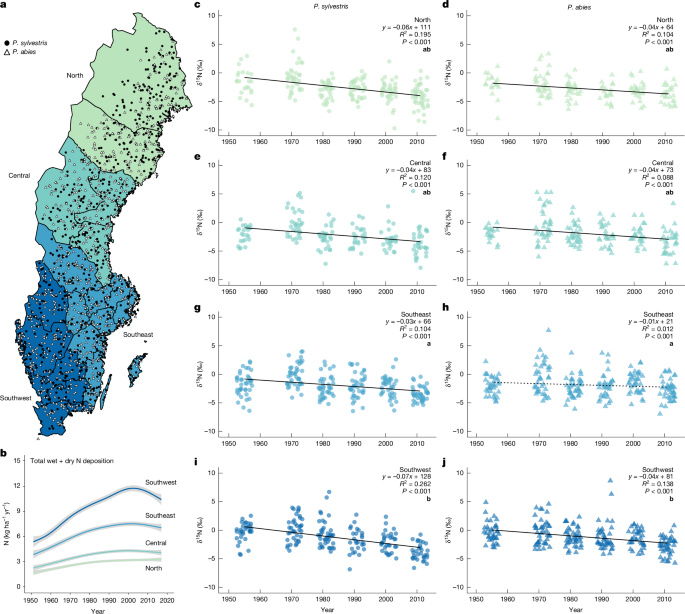
This study uses 1,609 archived tree cores (Picea abies and Pinus sylvestris) sampled across Sweden to build decadal δ15N chronologies spanning the mid-20th century to 2017. The authors used stratified random sampling and linear mixed-effects models to compare the roles of rising atmospheric CO2 and atmospheric reactive nitrogen (Nr) deposition on wood δ15N trends while controlling for temperature, basal area and spatial factors.
Key finding: wood δ15N values declined consistently across regions and species, and atmospheric CO2 emerged as the strongest predictor of this decline. Nr deposition variables had weak or inconsistent relationships with δ15N (NHx:NOy ratio was not significant). The results are interpreted as evidence that rising CO2 is tightening the nitrogen cycle (progressive nitrogen limitation, PNL) in boreal forests, reducing N availability and potentially limiting future CO2 fertilisation of forest growth.
Key Points
- Dataset: 1,609 independent tree-core samples (10-year growth segments) from Swedish National Forest Inventory archives covering 1950–2017.
- Primary metric: wood δ15N chronologies as an integrator of ecosystem N availability; declines indicate increasing N limitation (oligotrophication).
- CO2 was consistently the strongest predictor of declining δ15N for both species (Pinus sylvestris and Picea abies), with a negative relationship of δ15N vs CO2.
- Nr deposition variables (total N, NHx, NOy) showed only weak positive relationships with δ15N; NHx:NOy ratio had no significant effect, so changing deposition chemistry does not explain the observed declines.
- Mechanisms proposed: (a) increased plant N demand from CO2-driven growth depletes soil N and reduces fractionating N losses, (b) higher plant C:N and litter quality drive microbial N immobilisation, and (c) increased C allocation to ectomycorrhizal fungi changes N transfer and 15N fractionation.
- Forest growth increases since the 1950s correlate with more negative δ15N trends, supporting a PNL feedback where increased biomass demand reduces available N.
- Implication: progressive N limitation could constrain the future CO2 fertilisation effect in boreal forests and affect the distribution of carbon between above- and belowground pools.
- All data and R scripts are openly available via figshare (DOI provided in the paper) and the study leverages ISIMIP and CRU datasets for deposition and climate inputs.
Why should I read this?
Short version: if you care whether forests will keep soaking up our CO2, this matters. The paper shows robust, country‑wide tree‑ring evidence that rising CO2 is linked to less available nitrogen in boreal woods — and that could cap how much extra carbon forests can store. It’s a tidy, data‑heavy rebuttal to the idea that falling nitrogen deposition alone explains recent trends, and it flags a real constraint for climate models and forest management.
Author style
Punchy and direct: this is a well-controlled, large-scale empirical test. The authors used systematic archive sampling to avoid common tree‑ring pitfalls (age effects and N translocation), modelled competing drivers explicitly, and found CO2 the dominant signal. Given the global importance of boreal C stocks, the study’s conclusions are highly relevant — read the methods and models if you want to understand how confident we should be about PNL in northern forests.
Context and relevance
The work feeds straight into continuing debates about the strength and longevity of terrestrial carbon sinks under rising CO2. It provides independent isotopic evidence that CO2-driven increases in plant growth and changes to C:N dynamics can reduce ecosystem N availability — a process that Earth-system models and policy assessments must account for. For forestry, conservation and climate modelling, the finding signals potential limits to how much boreal forests can compensate for anthropogenic emissions.