

Microbiota-mediated induction of beige adipocytes in response to dietary cues
Article Date: 04 March 2026
Article URL: https://www.nature.com/articles/s41586-026-10205-3
Article Image: Figure 1
Summary
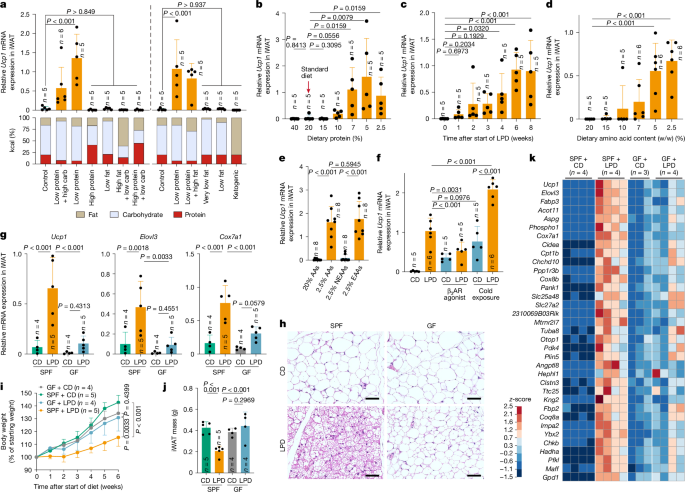
This Nature paper shows that a low-protein diet (LPD) robustly induces the formation of beige adipocytes in inguinal white adipose tissue (iWAT) in mice, and that this effect depends on specific gut microbes and two complementary host pathways. The authors combine germ-free and gnotobiotic mouse models, single-nucleus and bulk RNA-seq, metabolomics and cultured isolates (from mouse and human donors) to map mechanism to function. Key findings are: (1) LPD feeding upregulates classic beige markers (Ucp1, Elovl3, Cox7a1) in iWAT; (2) the browning is microbiota-dependent; (3) microbiota-driven increases in systemic bile acids activate adipose FXR in progenitor cells; (4) microbiota nitrogen metabolism (microbial nitrite→ammonia via NrfA/FDH) raises portal ammonia, inducing hepatic FGF21; and (5) FXR and FGF21 act in parallel to promote sympathetic remodelling and β3-adrenergic signalling that drive beige-cell biogenesis. Defined microbial consortia (mouse mu20/mu5 mixes and human-derived hu4 strains) with bile-acid-modifying and ammonia-producing capacities can transmit or recreate the effect under LPD conditions, improving metabolic readouts such as body-weight loss and glucose tolerance.
Key Points
- Low-protein diets (≈7% protein) induce strong induction of beige-fat signature genes in iWAT within 1–2 weeks and plateau by 6–8 weeks.
- LPD-induced browning is microbiota-dependent: germ-free or antibiotic-treated mice show markedly reduced induction.
- Two orthogonal microbiota→host pathways are required: bile-acid-mediated activation of FXR in adipose stem/progenitor cells, and microbiota-derived ammonia that induces hepatic FGF21.
- Bile-acid changes (increased unconjugated CA, MCA, CDCA, 7oxoDCA, UCA, UDCA) activate FXR; adipocyte- and Dpp4+ cell-specific FXR deletion reduces browning.
- Microbial NrfA-dependent nitrite reduction produces ammonia in protein-restricted conditions; portal ammonia specifically raises hepatic Fgf21 expression.
- Defined microbial consortia from mice (mu20, mu5) and humans (a 4-strain hu4 set) with complementary bile-acid and nitrogen-metabolism functions reproducibly enable LPD-induced browning and metabolic benefits in gnotobiotic mice.
- Intervention with tungsten (FDH inhibitor) or nrfA deletion in Bilophila reduces ammonia, FGF21 and browning — supporting a causal role for microbial nitrogen metabolism.
- LPD effects are depot-, age- and sex-dependent (iWAT responsive; females and aged mice show attenuated responses) and reversible after diet reversion.
- Although Ucp1 mRNA and morphology change, the paper notes limitations: Ucp1 expression alone doesn’t prove active thermogenesis and the exact sensing/communication mechanisms remain to be fully defined.
Context and relevance
This study places the gut microbiota centre-stage as an interpreter of dietary macronutrient composition — specifically protein scarcity — converting microbial metabolism into endocrine and local adipose signals that remodel tissue and metabolism. The dual-pathway model (bile acids → adipose FXR; ammonia → hepatic FGF21) explains how distinct microbial functions (bile-acid modification and dissimilatory nitrite reduction to ammonia) cooperate to produce a coherent host response: sympathetic neurone remodelling, beige adipocyte formation and measurable metabolic improvements. The findings connect several hot topics — diet composition, microbial metabolites, endocrine integrators (FGF21), nuclear receptors (FXR), and beige/brown adipose biology — and provide defined microbial consortia that transfer the phenotype. For researchers of microbiome–host interactions, metabolic disease and nutritional interventions, this paper offers mechanistic traction and tractable bacterial candidates for translational follow-up.
Why should I read this?
Short version: because it’s neat — the microbiota literally turns a low-protein diet into a two-pronged signal (bile acids + ammonia) that drives fat to become more thermogenic and metabolically active. If you care about diet, metabolites, obesity or microbiome therapeutics, these are actionable mechanisms and actual strains you can test. Also, the work bridges gnotobiotic proof and human-derived isolates, so it feels much closer to translational follow-up than many mouse-only studies.
Author style
Punchy: This is a must-read for anyone following diet–microbiome–metabolism crosstalk. The study provides clear mechanistic links (microbial bile-acid chemistry + NrfA-driven ammonia → FXR and FGF21) and isolates minimal consortia that reproduce the effect, making it highly relevant for future translational strategies in metabolic disease and microbiome-based interventions.
Limitations & open questions
Ucp1 mRNA dynamics do not guarantee active thermogenesis; the relative contribution of beige adipocytes versus other FGF21-mediated routes to weight loss remains to be parsed; how microbes sense low protein and selectively alter bile-acid circulation requires more work; and human relevance beyond donor-derived engraftment models needs careful clinical validation.