
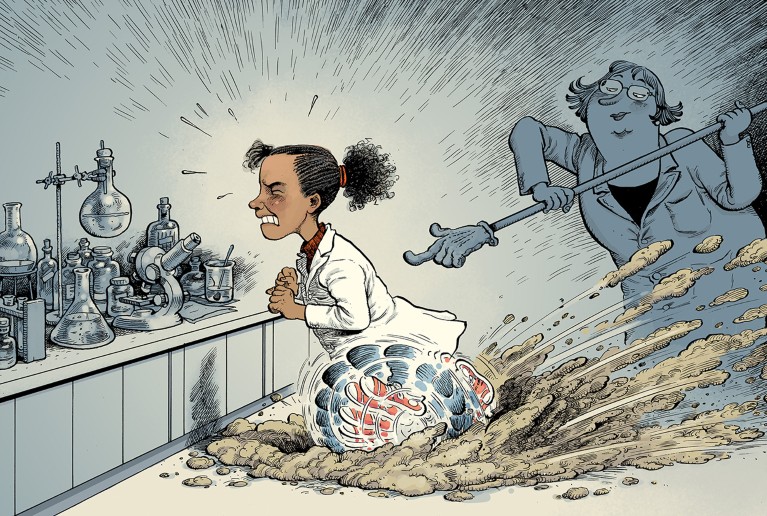
My PhD student is stuck. How do I teach them perseverance and problem solving?
Summary
A new principal investigator asks how to help talented incoming PhD students develop independence, resilience and effective problem-solving without becoming a helicopter supervisor. Nature’s Careers team consulted experienced PIs, who recommend practical lab-culture and mentoring approaches: build collaboration and peer support, normalise failure and teach students to analyse it, set realistic project expectations, pair newcomers with experienced lab members, and model resilience so students learn how to persist and pivot.
Key Points
- Foster a collaborative lab culture so students have multiple sounding boards rather than struggling alone.
- Remove the stigma around failure by discussing it openly and teaching students to distinguish technical errors from conceptual problems.
- Set realistic, incremental goals (“rice and beans”) to avoid overwhelming students and to encourage steady progress.
- Use peer pairing or mentorship within the lab to give newcomers a safe space to ask repetitive questions and practise skills.
- Model resilience and alternative approaches yourself so students see doubt and failure as part of scientific progress, not a sign of inadequacy.
Content summary
The article opens with a new PI’s concern that well-qualified students often lack experience dealing with experimental setbacks and can interpret early failures as personal incompetence. Four senior PIs share best practices. They emphasise building team-based support networks, pairing new students with experienced lab members, and creating an environment where failure is reframed as diagnostic information. Mentors should help students learn to analyse why experiments failed, to reset project scope when needed, and to consider alternative methods. Reducing pressure to publish early and encouraging modest, achievable milestones helps students develop technical competence and confidence. The piece stresses the mentor’s role in modelling calm problem-solving and persistence.
Context and relevance
The advice responds to widespread anxiety and burnout among graduate students and addresses a common gap: academic success to date does not automatically translate into research grit. For new PIs, lab managers and supervisors, these practices align with broader trends in mental-health-aware mentoring, reproducibility, and team-based science. Implementing the suggestions can improve student retention, productivity and wellbeing while producing more independent researchers.
Why should I read this?
Short version: if you run a lab (or are about to), this is the practical checklist you didn’t know you needed — quick fixes and mindset shifts that stop students spinning their wheels without you doing the work for them. It’s down-to-earth, easy to try, and saves you time in the long run by building independent, resilient researchers.
Author style
Punchy. The piece is written to give new PIs concise, actionable guidance rather than academic theory. If you’re supervising students, read the detail — it’s directly applicable to everyday lab management and will help you avoid common mentoring pitfalls.
Source
Article date: 09 March 2026
Author: N. G. Boeck
Source: https://www.nature.com/articles/d41586-026-00706-6