

A silicon chip that enables the creation of 4D cameras
Article Date: 11 March 2026
Article URL: https://www.nature.com/articles/d41586-026-00727-1
Article Image: 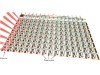
Summary
Researchers have built an integrated silicon photonic sensor that acts as a camera for 4D imaging — capturing not only 3D position but also velocity (time-varying information) of objects in a scene. The device combines on-chip coherent light arrays and photonic circuitry to encode angle and phase information across a large-scale array, enabling reconstruction of dynamic scenes at fingertip-sized scales. This work summarises Settembrini et al.’s demonstration of a large-scale coherent 4D imaging sensor and explains how the approach addresses prior limits in cost, power and scalability for motion-aware imaging.
Key Points
- The chip integrates coherent photonic elements to encode angle and phase, enabling extraction of depth and velocity from scattered light.
- Design is compact and scalable — the sensor fits on a fingertip-sized silicon chip and is designed for low power and manufacturability.
- 4D imaging here means measuring both 3D scene geometry and dynamical information (object motion/velocity) in real time.
- Potential applications include robotics, autonomous vehicles, augmented reality, industrial inspection and any system needing compact motion-aware sensing.
- Key challenges remain: on-chip readout complexity, noise and interference management, real-world robustness and integration with electronic systems.
Context and relevance
This development sits at the intersection of integrated photonics, computational imaging and LiDAR-like sensing. It follows a broader trend of moving optical functions onto silicon to make sensors smaller, cheaper and more power-efficient. By delivering coherent arrays and phase-sensitive detection on-chip, the work could shorten the path from lab prototypes to deployable motion-sensing hardware. For engineers and researchers, it points to new co-design needs: photonic hardware, signal-processing algorithms and system integration must be developed together to unlock real-world 4D imaging systems.
Why should I read this?
If you work with cameras, sensors, robotics or autonomous systems — or you’re just curious about how cameras might soon ‘see’ movement as easily as position — read this. It explains a neat trick: packing coherent light and phase readout onto silicon so a tiny chip can tell you where things are and how fast they’re moving. Saves you digging into the full paper unless you want the technical weeds.
Author style
Punchy: this is presented as a clear step-change in on-chip sensing. If you care about practical, scalable sensor tech, the article makes a strong case that coherent silicon photonics can move 4D imaging out of the lab and into real products.