

In vivo site-specific engineering to reprogram T cells
Article Date: 18 March 2026
Article URL: https://www.nature.com/articles/s41586-026-10235-x
Article Image: Figure 1
Summary
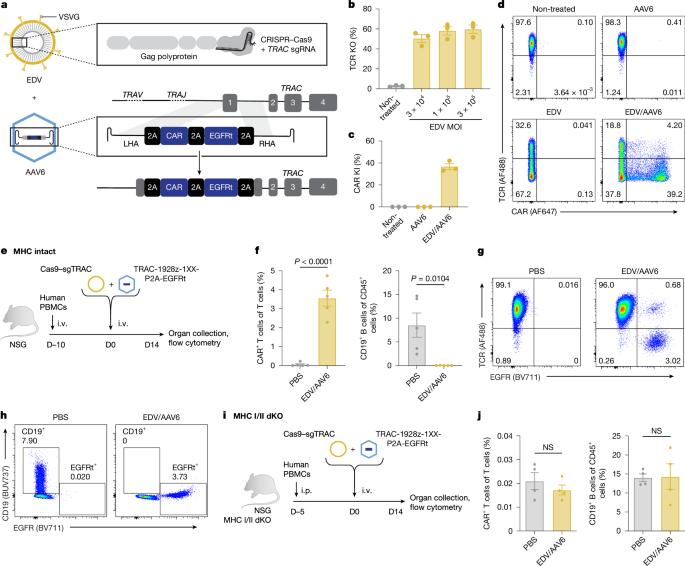
This Nature paper reports a two-vector in vivo method for site-specific integration of a large CAR transgene into the endogenous TRAC locus of primary human T cells. The authors combine CD3-targeted enveloped delivery vehicles (EDVs) that transiently deliver Cas9–sgRNA ribonucleoprotein with an evolved AAV capsid (AAV-hT7) that carries a promoterless HDR template encoding a CAR plus EGFRt. The evolved AAV resists neutralising serum antibodies and shows enhanced T cell tropism (CD7-associated uptake). Anti-CD3-EDVs both target and activate T cells, increasing HDR efficiency. In humanised mouse models the approach generated therapeutic levels of TRAC-integrated CAR T cells, produced rapid expansion and durable tumour control in models of B-ALL, multiple myeloma and a sarcoma model, and outperformed in vivo lentiviral approaches in several readouts. Key caveats include work in immunodeficient humanised mice, potential immunogenicity limiting redosing, and the need for larger-animal safety studies.
Key Points
- Dual-vector strategy: anti-CD3 EDVs deliver Cas9–RNP while AAV-hT7 delivers a promoterless HDR template to knock the CAR into TRAC, driving T cell-specific, physiological expression.
- AAV capsid evolution produced AAV-hT7, which is resistant to human serum neutralising factors and shows enhanced uptake linked to CD7 expression.
- Anti-CD3-EDVs confer T cell specificity and activation, increasing the pool of cycling T cells and boosting HDR-mediated knock-in efficiency.
- In vivo, the optimised anti-CD3-EDV + AAV-hT7 combination produced up to ~20% CAR+ splenic T cells and consistent B cell aplasia in treated humanised mice.
- In aggressive NALM6 B-ALL, multiple myeloma (OPM2) and a MES-SA sarcoma model, a single systemic dose led to widespread tumour control and durable responses in most animals tested.
- Compared with lentiviral approaches, TRAC-targeted in vivo edits expanded earlier, reached higher peak levels and produced more uniform, high CAR surface expression.
- Method reduces risks tied to constitutive promoter-driven expression (e.g. tumour cell CAR expression and antigen-negative relapse) by using a promoterless cassette under the TRAC promoter.
- Limitations: experiments used immunodeficient humanised mice, neutralising antibodies may limit redosing, and comprehensive safety/tropism studies in immunocompetent models (eg non-human primates) are required before clinical translation.
Context and relevance
CAR T therapies are effective but hampered by personalised ex vivo manufacturing, cost and variability. Prior in vivo CAR-generation attempts used randomly integrating viral vectors or transient mRNA/LNP approaches with coverage, specificity or durability limitations. This work demonstrates, for the first time to the authors’ knowledge, targeted integration of a large payload into primary human T cells in vivo, combining transient nuclease delivery and a durable HDR donor. The approach directly tackles three major barriers to clinical in vivo editing: vector serum neutralisation, cell-type specificity and limited cycling of target cells.
Why should I read this
Quick version: these researchers have essentially shown it’s possible to reprogramme human T cells inside the body with precise genomic targeting — skipping leukapheresis and manufacturing. If you follow CAR‑T, gene therapy, or biotech development, this paper is a neat shortcut to understand where the field might go next (and where the tricky safety questions lie).
Author style
Punchy: this is a potential game-changer for how cell therapies are delivered — it offers a credible path to off-the-shelf clinical workflows by marrying delivery engineering with precise genome targeting. Read the detail if you want to see the experimental design and limitations that will define next steps.