
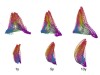
Charting the human brain’s lifelong functional organisation
Summary
Researchers have produced a continuous functional atlas that maps how patterns of connectivity across the human brain change from birth through to old age. The work (reported in a Nature paper by Taylor et al. and discussed here) identifies three core axes of functional organisation that emerge, mature and then decline at different stages of life. Basic sensory regions show early maturation, whereas higher-order association areas continue developing into adulthood and show later-age decline. The atlas provides a lifespan perspective on functional hierarchy and offers a normative reference for studies of development, ageing and disease.
Author style
Punchy: This is a big deal — a clear, continuous map of how the brain’s functional architecture shifts across life. If you work on development, ageing or brain imaging, the underlying paper is worth diving into; the commentary saves you time by highlighting the takeaways.
Key Points
- A continuous atlas charts changes in functional connectivity from birth to old age, rather than treating age in discrete chunks.
- Three principal axes of brain organisation were tracked: sensory-to-association gradients that show staggered maturation and decline.
- Sensory and unimodal areas mature early; heteromodal and transmodal association cortices mature later and decline later in life.
- The atlas complements prior structural lifespan charts and helps link maturation of function to behaviour and cognition.
- Provides a normative baseline useful for detecting atypical development or accelerated ageing in disease.
- The work builds on large-scale imaging and gradient-mapping approaches to reveal continuous developmental trajectories.
Context and relevance
This commentary situates the new functional atlas within ongoing trends in connectomics and lifespan neuroscience. By offering a continuous picture of functional hierarchy across age, the atlas bridges gaps between developmental neuroscience and studies of ageing, and it strengthens attempts to relate imaging markers to cognitive trajectories and clinical outcomes. It also complements structural lifetime charts and supports efforts to define normative models that can flag deviations in neurodevelopmental or neurodegenerative conditions.
Why should I read this?
Short answer: because it gives you the big picture without wading through the full paper. The atlas is the kind of map that helps researchers and clinicians spot whether a brain looks typical for someone’s age — handy if you want to understand development, ageing or brain disorders faster. Plus, it points to where future biomarkers and interventions might focus.