
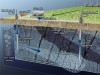
Pilot project paves way to storing CO2 underground as minerals in arid countries
Article Date: 25 March 2026
Article URL: https://www.nature.com/articles/d41586-026-00635-4
Article Image: https://media.nature.com/lw100/magazine-assets/d41586-026-00635-4/d41586-026-00635-4_52208452.jpg
Summary
Researchers have demonstrated a pilot process that dissolves CO2 in water, injects the solution into porous subsurface rock, and then recirculates the water so it can be reused. The reaction with rock forms stable carbonate minerals, locking CO2 away permanently. Crucially, recirculating the injected water slashes the water demand compared with older approaches — addressing the main barrier to mineral storage in water-scarce, arid regions.
Key Points
- The pilot study shows CO2 can be mineralised in the subsurface by injecting CO2-rich water into porous rock.
- Recirculation of the injection water greatly reduces water consumption, improving feasibility in arid countries.
- Previous methods required 20–50 times more water by mass than the CO2 sequestered; recirculation narrows that gap significantly.
- Mineral storage converts CO2 to stable carbonate solids, lowering long-term leak risk compared with some other storage methods.
- The demonstration is an industrial-scale first, signalling practical progress toward deployment over the next two to three decades.
- Remaining challenges include site selection, scaling, monitoring and ensuring environmental safeguards during injection and recirculation.
Content summary
Many nations agree deep geological storage of CO2 will be needed to meet climate targets. One promising route is to dissolve CO2 in water and inject it into reactive rock where it precipitates as carbonate minerals. However, earlier trials used huge volumes of water (often 20–50 times the mass of CO2 sequestered), making the approach impractical in arid regions. The new pilot reported by Oelkers et al. demonstrates co-injection with recirculating water: the injected fluid is recovered, treated and reused, dramatically cutting freshwater demand.
The pilot confirmed mineral formation in the subsurface and provided operational data on flow, reaction rates and water reuse. This reduces a key environmental and logistical barrier — water availability — and broadens where mineral storage could be deployed. The study also ties into broader literature on mineralisation, monitoring methods and lifecycle impacts, while noting further work is needed on upscaling and long-term monitoring.
Context and relevance
This advance matters because it tackles one of the main constraints on subsurface mineral storage: water use. Arid and semi-arid regions — many of which are high on CO2 emissions and vulnerable to climate impacts — have been poor candidates for mineral storage until now. By demonstrating a feasible recirculation approach at pilot scale, the work opens the door to wider geographic deployment and contributes to the portfolio of carbon-storage options that policymakers and industry must consider.
The pilot complements trends in carbon management: increasing emphasis on permanent storage methods, tighter scrutiny of environmental impacts (including water footprint), and the need to diversify storage strategies across regions and geology. For engineers, regulators and climate planners, the demonstration provides real-world operational data that can inform design choices, permitting and risk assessments.
Author (punchy)
This is a proper step-change. A pilot that actually reduces water demand makes mineral storage believable for dry countries — not just a lab curiosity but a route that could be scaled with the right investment and regulation. Read the full paper if you’re involved in carbon management policy, subsurface engineering or climate strategy: the operational detail will matter.
Why should I read this?
Quick and blunt — if you care about practical, long-term ways to lock away CO2, this is exactly the kind of real-world progress you want to know about. It solves a water problem that used to rule out whole regions. Saves you time: instead of wading through theory, this pilot gives usable, real-world outcomes and shows where next to focus effort.