CO2 subsurface mineral storage by its co-injection with recirculating water
Summary
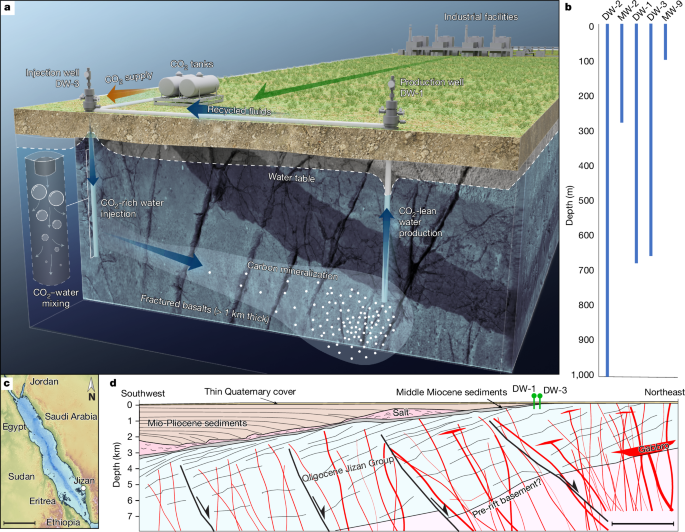
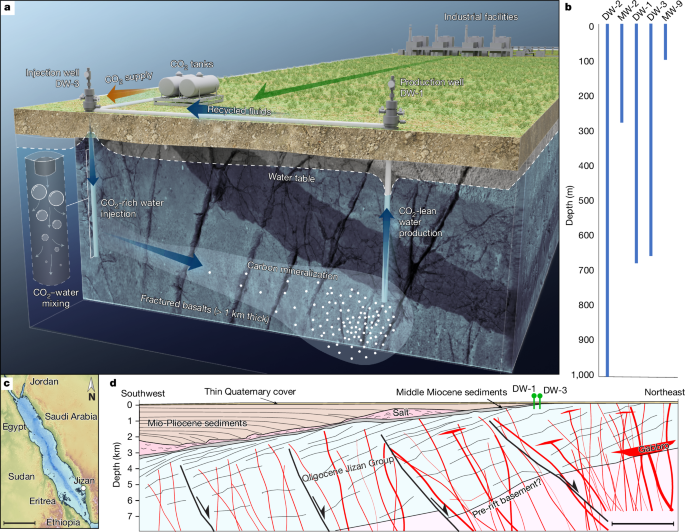
This Nature pilot (Jizan, Saudi Arabia) demonstrates that injecting CO2 dissolved in subsurface water and recirculating that water between two nearby wells in a fractured basalt can drive rapid mineralisation of injected carbon. Over a ~10-month field test the team injected ~131 tonnes of CO2 (co-injected with inert tracers) and found chemical and solid evidence that about 70 ± 5% of the injected carbon was fixed as carbonate minerals (chiefly calcite, ankerite and siderite) within the target volume. Key evidence includes fluid chemistry changes, tracer behaviour (NaF and SF6) and carbonate cements recovered from a damaged pump with isotopic signatures consistent with the injected CO2.
Content summary
Site and method: five wells were drilled into 21–30 Ma fractured basalts of the Jizan Group. Water was produced from one well (DW-1), CO2 was bubbled into a downhole carrier-water stream and the CO2-charged water was injected into a second nearby well (DW-3). The system was closed from the atmosphere and water was continuously recirculated at ~2.6 kg s−1.
Monitoring and tracers: an NaF slug characterised flow pathways and residence times; SF6 was co-injected with CO2 as an inert tracer. Fluid sampling (pH, alkalinity, major elements, isotopes) tracked dissolution of basalt minerals and later precipitation of carbonates and clays. Deconvolution and tracer-based calculations were used to estimate the fraction of CO2 removed from the aqueous phase by mineral precipitation.
Results: fluid DIC rose when the CO2 plume arrived then declined faster than conservative tracers, indicating removal by reaction. By 21 April 2024 ≈70 ± 5% of injected CO2 had been mineralised. Solids recovered from the production pump were cemented with up to ~14% calcite and smaller amounts of siderite and ankerite; isotopic ratios match precipitation from the injected CO2-bearing water.
Implications and limits: recirculation eliminates the need for importing water (critical in arid regions), uses lower surface CO2 delivery pressures (~12–14 bar) than many conventional CCS approaches, and exploits basalt reactivity in fractured systems. Upscaling could enable significant storage in basaltic provinces, but pore-space loss to secondary silicates and carbonate growth will limit long-term capacity per pore volume; effective swept volumes in the pilot correspond to an upper bound of ~22,000–40,000 tonnes CO2 mineral storage if all pore space precipitated calcite (likely an overestimate).
Key Points
- Pilot location: Jizan basalts (Saudi Arabia); purpose-built two-well recirculation test in fractured volcanic rocks.
- Method: CO2 dissolved into subsurface reservoir water and continuously recirculated between production and injection wells to promote non-buoyant, acidic fluids that accelerate silicate dissolution and carbonate precipitation.
- Scale of injection: ~131 tonnes CO2 injected (with SF6 and NaF tracers); continuous water circulation March 2023–April 2024.
- Outcome: ~70 ± 5% of injected CO2 mineralised within ~10 months, based on two independent tracer approaches and solid-phase analyses.
- Evidence: temporal pH/DIC trends, increased dissolved Si/Mg/Ca, tracer-deconvolution mass balances, carbonate cements on pump with δ13C/δ18O consistent with injected CO2.
- Advantages: no external water required, lower injection pressure needs, reduced buoyancy risk (CO2 remains dissolved), and compatibility with arid regions that lack sedimentary traps.
- Constraints: storage limited by available pore space and by formation of non-carbonate secondary minerals (clays/zeolites); heterogeneous fracture–matrix flow requires multi-well designs for upscaling.
Context and relevance
This field demonstration builds on and extends CarbFix-style basalt mineralisation approaches by showing a recirculation design that avoids importing surface water — a crucial advance for arid oil- and industry-heavy regions. It contributes practical data on reaction times, tracer methods, and the balance between fast fracture flow and slower matrix residence times. Policymakers and engineers planning CCS in water-scarce regions (Middle East, parts of Africa, Australia) should note this as a scalable option that trades injected pressure for in-situ water recirculation and rock reactivity.
Why should I read this?
If you care about real-world CO2 disposal — not just theory — this is a tidy, practical demo that actually turned most of the gas into rock without hauling fresh water around. Fast mineralisation, low surface pressures and a design for arid environments mean this could be a game-changer for regions that can’t use deep saline traps. Quick read, big implications.
Author style
Punchy: this paper delivers field-tested evidence that mineral carbonation in basalts can be effective and water-self-sufficient. Read the full methods if you need the tracer maths or want to replicate the well layout and monitoring protocol.
Source
Article Date = 2026-03-25
Article URL = https://www.nature.com/articles/s41586-026-10130-5
Article Title = CO2 subsurface mineral storage by its co-injection with recirculating water
Article Image = Figure 1 (overview)