
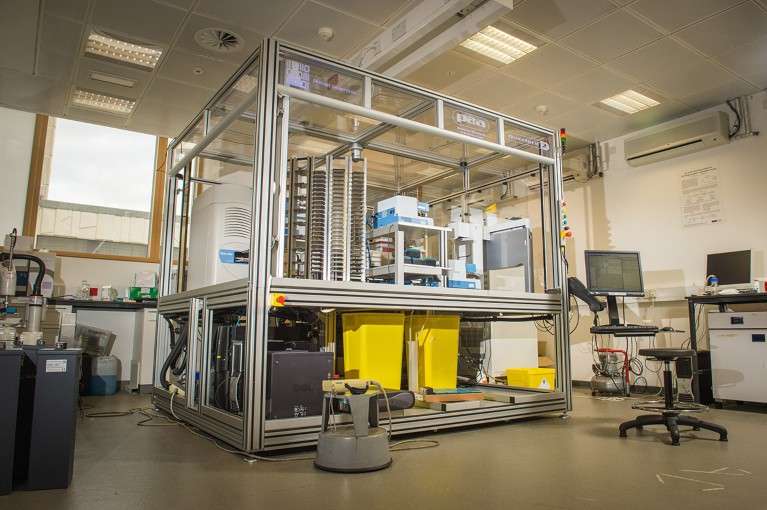
Inside the ‘self-driving’ lab revolution
Article Date: 2026-03-30
Article URL: https://www.nature.com/articles/d41586-026-00974-2
Article Image: 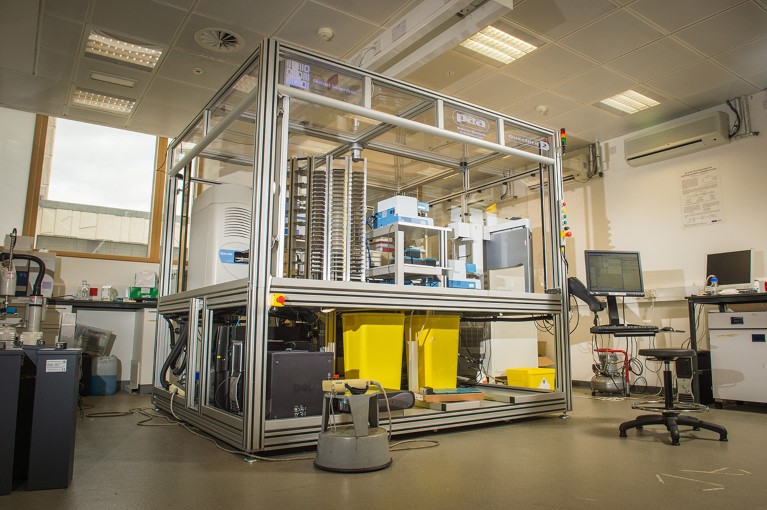
Summary
The article surveys the rapid rise of ‘self-driving’ laboratories that combine robotics, automated instruments and AI to design, run and analyse experiments with minimal human input. It profiles trailblazers such as Ross King’s Eve (and predecessors Adam and Genesis), Alán Aspuru‑Guzik’s Acceleration Consortium, Coscientist at Carnegie Mellon (driven by GPT‑4), Lila Sciences’ AI Science Factory and startups like Periodic Labs and LabGenius.
These platforms can screen thousands of conditions, run complex multi-step protocols, use computer vision to monitor reactions, and in some cases reduce costs and improve yields compared with conventional lab work. Current limits remain: human dexterity, validation of AI predictions and the fact most tasks automated so far are incremental optimisations (often using Bayesian approaches). But improvements in LLMs, sensors and automation are extending what can be tackled autonomously.
Context and relevance
Self-driving labs are moving from proof-of-concept projects to scalable services and industrial labs able to run thousands of experiments per day. They matter to researchers, R&D managers and investors because they promise faster discovery, lower per-experiment costs and new business models (cloud labs, AI-driven service factories). The technology intersects with broader trends: cloud automation, LLMs for scientific planning, and advances in lab robotics and sensing.
Key Points
- Robots like Eve and Adam can autonomously generate hypotheses, design experiments and carry them out, enabling discoveries such as a potential new malaria target.
- Self-driving labs blend AI, robotics and instrumentation to go beyond routine automation and handle planning, analysis and iterative experiment design.
- Systems range from single-site giants (Lila Sciences’ AISF) to distributed consortia (Acceleration Consortium) and startups (Periodic Labs, LabGenius, Coscientist).
- Demonstrable gains include throughput increases and cost reductions — e.g., a reported 40% cut in cost-per-gram of protein in a GPT‑5 + Ginkgo experiment, with yield improvements.
- Limitations remain: robots lack human dexterity, many workflows still need human validation, and current autonomous work often focuses on constrained, incremental optimisation problems.
- Advances such as LLM-guided experiment planning and computer vision are expanding capabilities to multistep syntheses and real‑time reaction control.
- Economic logic: once throughput and reliability improve, autonomous labs can shift lab work from artisanal craft to factory-like production, changing how research is organised and scaled.
Why should I read this?
Short answer: because this is where lab work is headed — fast. If you care about research speed, R&D budgets, or whether your next collaborator will be a robot, this piece gives a clear tour of who’s doing what and why it matters. It saves you time by summarising the main players, real-world wins and the practical limits to expect right now.
Author style
Punchy: the article pulls together vivid lab examples and measurable outcomes to show that self-driving labs are more than hype — they’re an industrial-scale shift in how experiments get done. If you manage or fund lab work, read the detail: the operational and cost implications could be material.