
Daily briefing: NASA’s Artemis II Moon mission launches
Summary
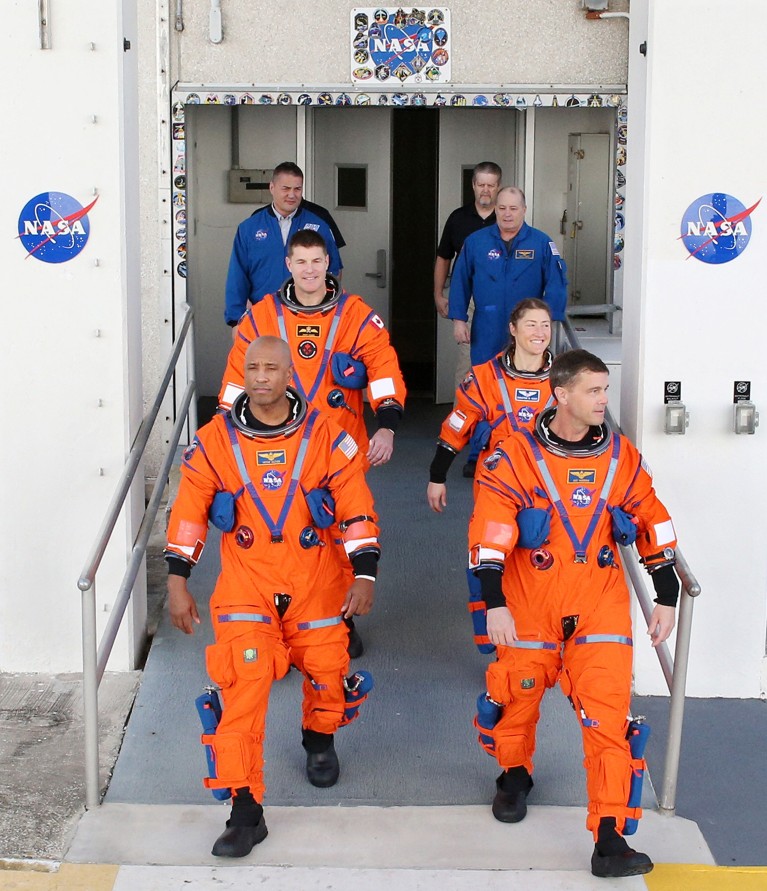
NASA plans to launch Artemis II, a four-person crewed mission that will travel around the Moon. The flight is primarily a test of crewed deep-space operations but includes scientific experiments focused on human health in deep space (for example, ‘organ-on-a-chip’ radiation tests) and geological observations from viewpoints never seen by human eyes before. The mission carries a string of notable firsts and will use the Space Launch System (SLS) rocket with people on board for the first time since Apollo.
Key Points
- Artemis II will be the first crewed mission beyond low-Earth orbit since Apollo 17 (1972).
- Science aboard focuses on human-health experiments (organ-on-a-chip radiation tests) and geological reconnaissance that leverages astronauts’ observational skills.
- Some scientists are ambivalent: they see Artemis II largely as a test flight and question costs and political context versus gains from uncrewed missions.
- Notable firsts: Victor Glover (first person of colour beyond LEO), Christina Koch (first woman), Jeremy Hansen (first non-US citizen), and possibly the farthest humans from Earth.
- Other briefs in the same issue: a waning but still puzzling H5N1 outbreak in US cattle, rising concern over AI-generated (‘hallucinated’) citations in published research, and conservation work to feed endangered Hawaiian snails by culturing leaf microbes.
Why should I read this?
Because it’s one neat package: a historic spaceflight (people > Moon), clever human-health experiments, and a snapshot of wider science trouble-shooting — from cow flu to AI-made fake citations. Short, punchy and tells you what actually matters without the fluff. We read it so you don’t have to scroll forever.
Context and relevance
Artemis II is important for space policy and long-term plans for a crewed lunar presence, but many researchers note it’s an early, high-cost step rather than an immediate science bonanza. The mission highlights ongoing debates about the value of crewed versus uncrewed exploration, budget priorities, and how to balance inspirational milestones with efficient science. Meanwhile, the briefing ties in wider scientific concerns: tracking an unusual H5N1 outbreak in cattle, the implications of AI fabricating references in academic literature, and small-scale conservation challenges that speak to biodiversity loss.