
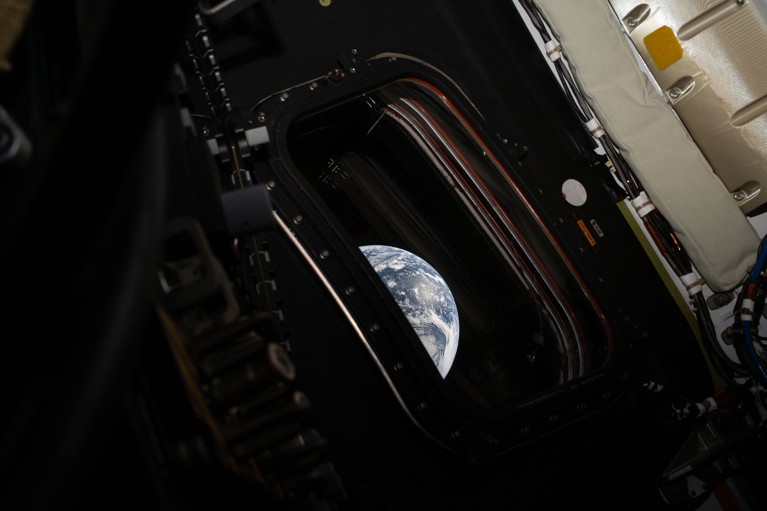
Artemis II astronauts fly by the Moon today: follow along with Nature live
Article Date: 06 April 2026
Article URL: https://www.nature.com/articles/d41586-026-00989-9
Article Image: 
Summary
Nature’s live coverage from Houston follows Artemis II as its crew flies behind the Moon on 6 April 2026. The Orion capsule — named Integrity for this mission — has entered the lunar sphere of influence and will pass behind the Moon at closest approach today, allowing astronauts to photograph and observe portions of the lunar far side never seen by human eyes. The crew will set a human-distance record and later witness a partial solar eclipse from space during the fly-by.
Key Points
- Artemis II launched on 1 April 2026 and after initial Earth orbits set course for the Moon.
- The spacecraft is now in the Moon’s sphere of influence and will pass behind the Moon on 6 April 2026.
- Astronauts will photograph and observe the far side of the Moon through Orion’s large windows during a roughly six-hour period.
- The mission will set a record for the farthest distance travelled by humans and includes nearly an hour observing a solar eclipse from the spacecraft’s perspective.
- Nature’s correspondent Alexandra Witze reports live from Houston, capturing the atmosphere at mission control and the scientific interest in the fly-by.
Content Summary
The article is a live-report style update: it summarises the mission timeline, current spacecraft status, and what to expect during the closest approach behind the Moon. It highlights crew activities (photography and observation at the windows), mission timings for the fly-by (Houston local times), and the broader human-interest scene at NASA mission control. Witze adds context about the mission name, the crew’s preparations and the significance of human eyes seeing the far side.
Context and Relevance
This fly-by is a landmark moment for the Artemis programme and for human spaceflight: it’s the first crewed mission to loop around the Moon in this programme and will return unique human observations of the lunar far side. The event ties into wider efforts to return humans to the lunar surface and to expand scientific observations and international activity in lunar exploration. For planetary scientists, photographers and the general public, the mission provides fresh data, images and a high-profile demonstration of NASA’s deep-space human-capability work.
Why should I read this?
Quick and honest: if you care about cool space moments, rare lunar views or tracking the next phase of human exploration, this live update saves you time — it tells you what matters right now and when the key events happen. Plus, you get the scene-setting from inside mission control without scrolling through a dozen updates.
Author style
Punchy: Alexandra Witze writes with immediacy and focus — great for readers who want the essential facts and the live feel of a mission control room. The piece packs the operational timeline and human reaction into short, vivid dispatches.